Principle of operation The transmission system consists of the following components:
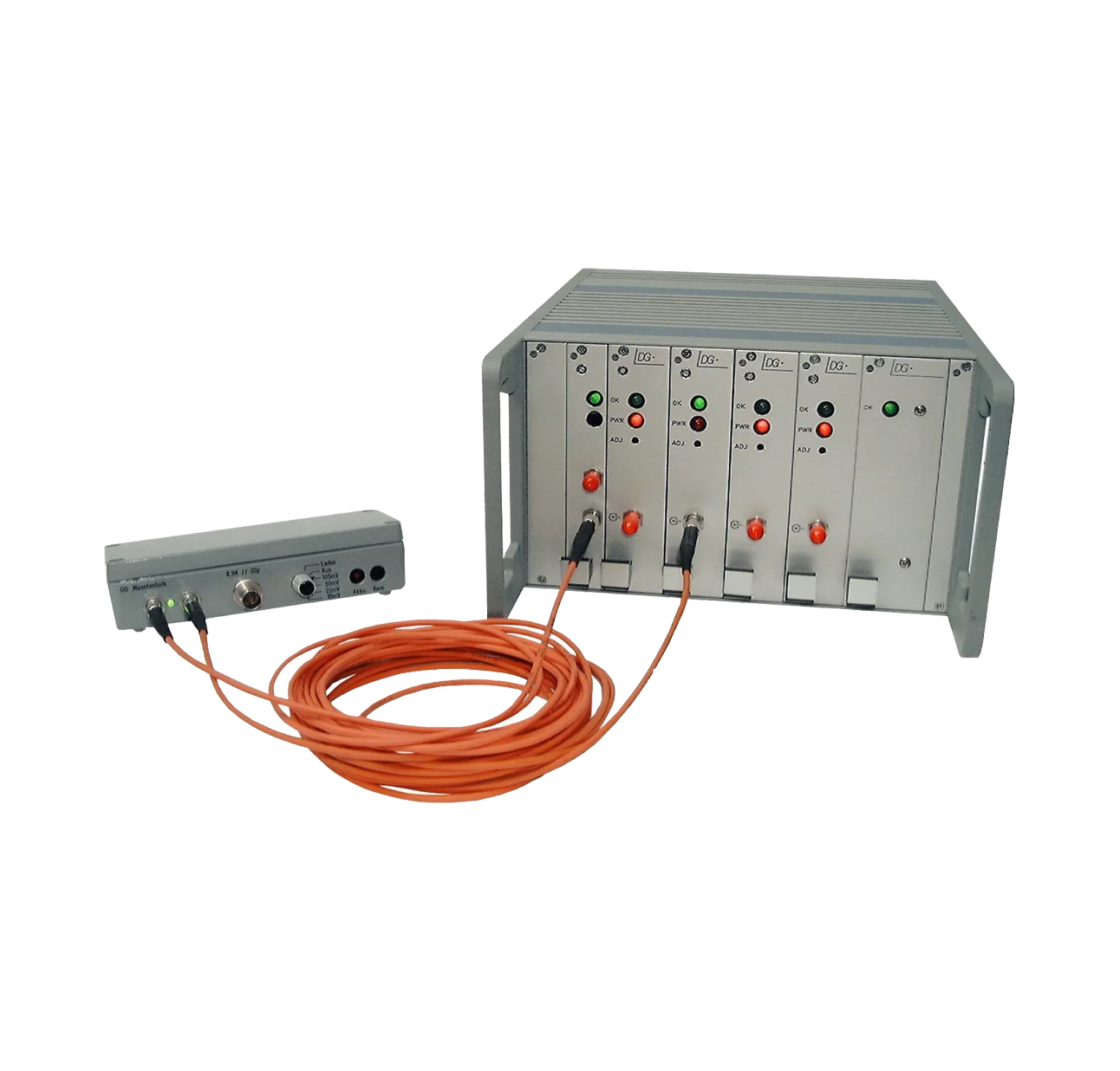
Transmitter Optical fiber Receiver The transmitter modulates infrared light emitted by the diode with conditioned signals representing measurable values. This amplitude-modulated light is transmitted via optical fiber to the receiver, which converts the optical signals back into voltage. Fiber attenuation is automatically compensated (AC versions) or semi-automatically using a compensation switch (DC versions). Insufficient optical level (violation of upper or lower dynamic range limits) is detected and indicated.
For measurement convenience in extended equipment or in cases where transmitters are hard to access, devices can be equipped with a remote start function via a second optical fiber. These transmitters switch from a low-power standby mode to measurement mode using optical pulse telegraphy. Standby operation can last several years.
In addition to transmitting voltage signals from passive sensors, shunts, or dividers, the transmitter units can be further equipped with signal processing circuits for active sensors and power supply.