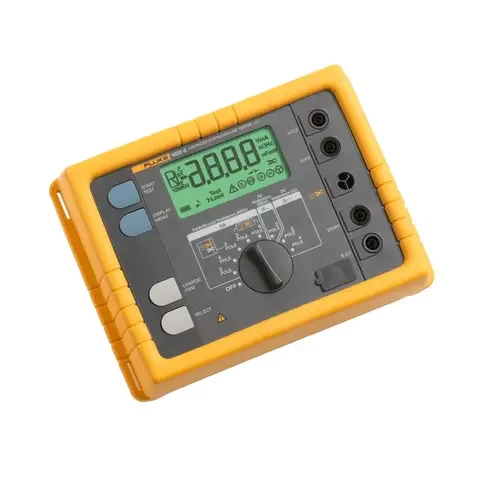
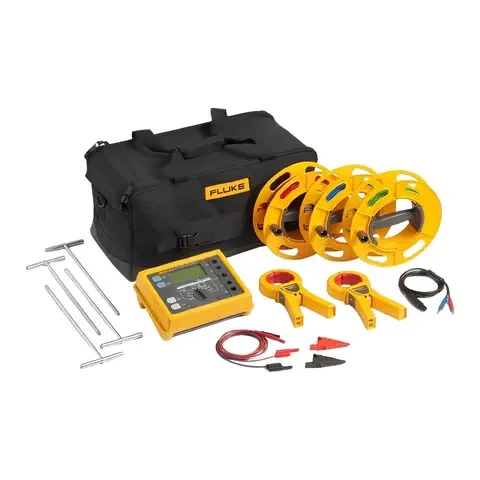
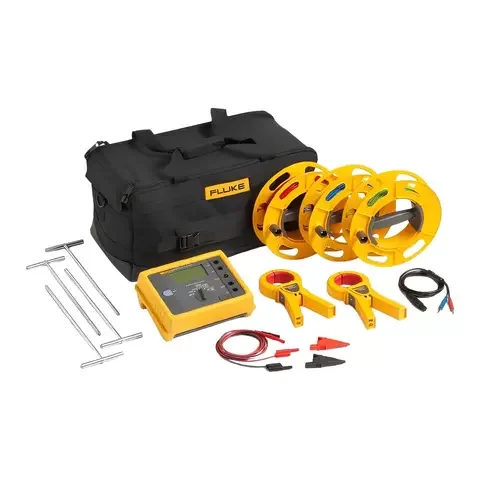
A ground resistance tester supporting 4 measurement types and capable of storing up to 1500 records in memory. Equipped with a large display and compact design.
The Fluke 1625-2 ground resistance tester allows data storage and file transfer via USB port. World-class accessories simplify and speed up testing.
The device can measure ground loop resistance using only clamps. When using this method, two clamps are placed near the ground rod, each connected to the meter. Ground electrodes are not used. One clamp applies a known fixed voltage, and the other measures the current. The meter then automatically calculates the resistance of the ground rod. This testing method is effective only if there is a connected grounding system on the structure or building, which is usually the case. If only a single grounding loop exists, common in residential buildings, the clamp method is ineffective, and voltage drop testing should be used.
When using the clamp method, it is not necessary to disconnect the ground rod — the connected grounding system remains active during testing. This eliminates the need to install and connect each rod, saving significant time. Ground resistance testing can also be performed in locations previously inaccessible, such as inside buildings, on power line supports, or where ground surface access is limited.